AI marketing is not a magic button that automatically produces customers. Used well, it is a practical set of tools that helps a business respond faster, create useful content more consistently, understand what prospects need, and move inquiries toward the right next step.
For a local service business, that next step is usually concrete: a phone call, contact form, quote request, consultation, appointment booking, chatbot handoff, email signup, or new record in a customer relationship management system. The value of AI is not the technology by itself. The value is making those customer paths clearer and easier to manage.
What does an AI-assisted lead actually look like?
An AI marketing system should connect interest to an action your team can see and follow up on. Leads may arrive as:
- A phone call from a visitor who found the right service page.
- A completed contact or estimate form.
- An appointment or consultation request.
- A chatbot conversation handed to a staff member.
- An email or text opt-in with permission to follow up.
- A qualified inquiry saved in your CRM with the requested service and contact details.
If the system cannot show where inquiries go, who responds, and what happens next, it is not yet a complete lead flow.
1. Faster answers when customers are ready to act
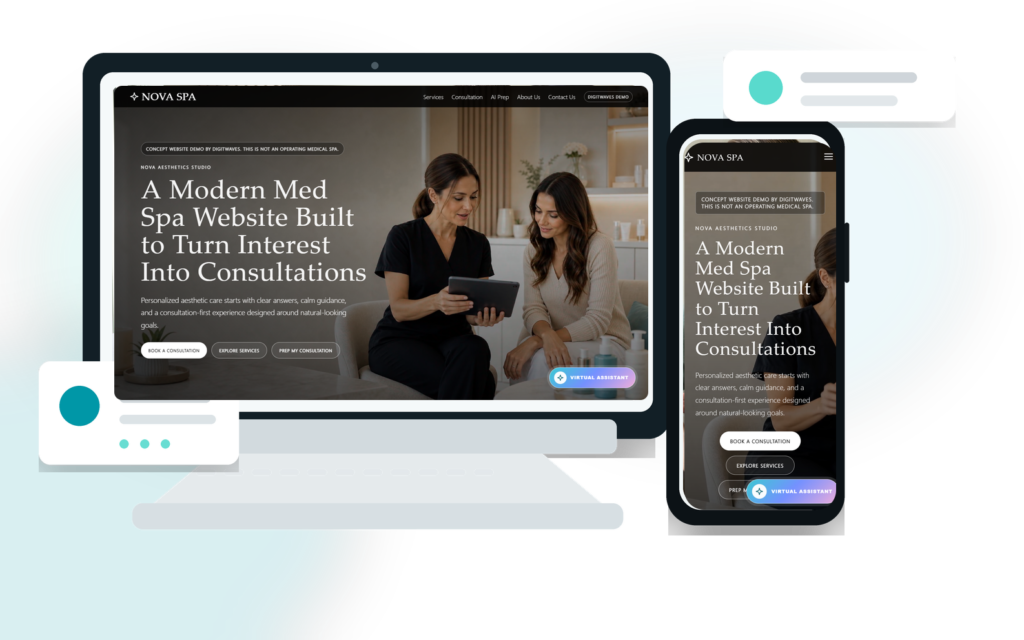
Local customers often research after business hours, between appointments, or while comparing several providers on their phones. An AI-assisted website can answer common questions about services, preparation, service areas, scheduling, or the quote process when a staff member is not immediately available.
This does not mean allowing a chatbot to invent prices, guarantees, medical advice, or legal guidance. A useful assistant works from approved business information, stays within clear limits, and offers a human handoff when the question needs judgment. The benefit is faster clarity and an easier path to call, book, or request more information.
2. Better lead capture and qualification
A generic “Contact Us” form often leaves the business with very little context. AI-supported intake can ask a short sequence of relevant questions based on the service a visitor selects. A roofing prospect might identify the property type and urgency. A med spa visitor might choose the treatment category they want to discuss. An HVAC customer might indicate whether the issue is an emergency or a maintenance request.
That information can be sent to email, a booking system, or a CRM so the team knows what the person needs before responding. The goal is not to reject people automatically. It is to reduce back-and-forth and help staff prioritize and prepare for better conversations.
3. More consistent follow-up
Many leads are lost because the first response is slow, a reminder is forgotten, or the inquiry never reaches the right person. AI and automation can support simple follow-up steps such as confirming a request, notifying the team, sending an appointment reminder, or prompting a staff member when an inquiry has not been answered.
The best follow-up still feels human. Messages should clearly identify the business, respect consent, avoid pressure, and make it easy for the customer to reply or opt out. AI should help the team stay organized; it should not create an endless stream of generic messages.
4. Useful content created more efficiently
AI can help turn business knowledge into first drafts for service pages, frequently asked questions, emails, social posts, short videos, and article outlines. One approved topic can be adapted into several formats instead of being recreated from scratch for every channel.
The time savings are real only when there is a review process. Someone who understands the business should check facts, tone, offers, locations, credentials, and claims before anything is published. The strongest content starts with genuine customer questions and real expertise, then uses AI to organize and repurpose that information.
5. More relevant customer experiences
Not every visitor needs the same message. Someone searching for emergency plumbing needs a direct call option. A homeowner planning a remodel may want project examples and an estimate process. A prospective dental patient may first need insurance, financing, or appointment-preparation information.
AI can help organize website paths, recommend relevant information, or tailor follow-up based on the service a person has already expressed interest in. This kind of relevance is useful when it reduces confusion. It becomes intrusive when a business collects more personal information than it needs, so personalization should remain transparent and privacy-conscious.
6. Smarter advertising and measurement
Modern advertising platforms use AI to adjust bids, match ads to searches, test creative combinations, and identify patterns across signals such as device, location, and time of day. These systems can help a small team manage more variables than it could handle manually.
Automation still needs a clear goal and reliable conversion tracking. If the platform is told that every click or page view is equally valuable, it may optimize for activity instead of qualified inquiries. Define the action that matters—such as a completed booking, call, or quote request—and review lead quality, cost, location, and service fit regularly.
7. More time for higher-value work
AI is especially helpful with repetitive marketing work: organizing notes, summarizing inquiry trends, drafting variations, routing form submissions, or preparing reports. Reducing that manual load gives owners and staff more time for sales conversations, customer service, creative judgment, and the work customers actually hire them to perform.
The practical goal is not to remove people from marketing. It is to use people where judgment, empathy, trust, and accountability matter most.
Where should a small business start?
Start with one bottleneck rather than buying several disconnected AI tools. A simple rollout looks like this:
- Choose one customer problem. Examples include unanswered after-hours questions, incomplete quote requests, slow follow-up, or inconsistent content.
- Define the desired action. Decide whether success means a call, booking, form submission, consultation, or qualified CRM record.
- Use approved information. Give the system accurate services, service areas, policies, offers, and escalation rules.
- Connect the handoff. Make sure every inquiry reaches a real inbox, calendar, phone, or CRM workflow with a responsible owner.
- Measure quality, not just volume. Review whether the inquiries are relevant, reachable, within the service area, and moving toward real conversations.
- Improve with human review. Update answers, forms, messages, and targeting based on what customers and staff actually experience.
What AI marketing should not do on its own
AI output can be inaccurate, overconfident, repetitive, or based on incomplete information. Keep a person responsible for reviewing public claims and important customer interactions. Do not use AI to create fake reviews, fake case studies, guaranteed outcomes, or unsupported medical, legal, financial, or performance claims.
Businesses should also be careful with personal and sensitive information. Collect only what is needed, explain how information will be used, protect access, and follow the rules that apply to the industry and location. For regulated services, AI should support education and intake—not replace licensed professional judgment.
The biggest benefit is a clearer customer path
AI marketing works best when it helps the right visitor get a useful answer, take a clear action, and reach a real person without unnecessary friction. It should strengthen a sound website and follow-up process, not hide a broken one.
DigitWaves helps small businesses plan AI-enabled websites and lead flows around calls, bookings, consultations, and quote requests.