
AI agents are starting to move beyond answering questions. The next step is helping people compare options, fill out forms, book appointments, and make purchases with less manual clicking.
For small businesses, that shift matters. A future customer may not browse every page themselves. Their AI assistant may be the one reading your site, comparing your offer, checking your hours, and deciding whether your business is easy enough to contact.
What agent purchasing means
Agent purchasing is when a person asks an AI assistant to help complete a buying task. That might mean ordering a product, booking a service, requesting a quote, or narrowing down the best provider before the person gives final approval.
The important part is not that people disappear from the process. The important part is that the website has to be clear enough for both people and software to understand what can be done next.
Where Google’s WebMCP fits
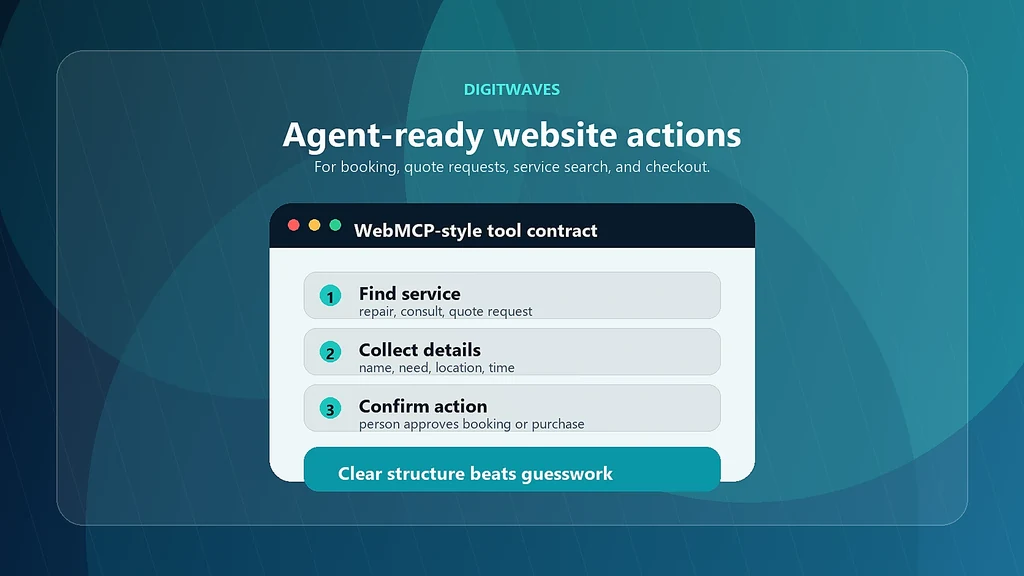
Google has previewed WebMCP as an early web standard for making websites easier for browser-based AI agents to use. Instead of forcing an agent to guess what every button, form field, or checkout step means, a site can expose structured tools that describe the available actions.
In plain English: WebMCP is a way for a website to tell an AI agent, “Here is the search tool, here is the booking form, here is the checkout action, and here is the information required to complete it.”
That matters because guessing from a page layout is fragile. A structured tool is cleaner, faster, and less likely to send the agent down the wrong path.
Why this matters for small businesses
Most small businesses are still built for a visitor who slowly reads the homepage, clicks the menu, scans a service page, and then decides whether to call. That still matters, but it is no longer the whole picture.
If AI assistants become part of everyday search and shopping behavior, your website needs to make the basics obvious:
- What services you offer.
- Who the service is for.
- What area you serve.
- What a customer should do next.
- What information is needed to request a quote, appointment, or consultation.
For a med spa, that could mean clearer consultation paths. For an HVAC company, it could mean repair request forms that agents can understand. For a contractor, it could mean project type, location, budget range, and timeline fields that are easy to parse.
This is not only an ecommerce issue
When people hear “agents buying for people,” they usually think about ecommerce. But local service businesses should pay attention too.
The same pattern applies to booking a consultation, requesting emergency service, choosing a provider, joining a maintenance plan, or preparing intake details before a call.
What to prepare now
Small businesses do not need to chase every new AI standard immediately. The smart move is to build the website foundation that makes future agent support easier.
- Use clear service pages instead of vague “what we do” sections.
- Make forms simple, labeled, and focused on real customer intent.
- Keep calls, bookings, quote requests, and consultation steps easy to find.
- Use honest trust signals: photos, process, service areas, credentials, and clear policies.
- Keep pricing, timelines, availability, and next steps as clear as the business can reasonably make them.
That work helps human visitors today and makes the site more prepared for AI-assisted browsing tomorrow.
DigitWaves’ take
The businesses that win this next phase will not just have prettier websites. They will have websites with clear offers, clean structure, strong visuals, and customer actions that are easy for people and AI assistants to understand.
For high-value small businesses, that means building around calls, bookings, consultations, quote requests, and better-qualified inquiries.
The practical takeaway
WebMCP is still early, but the direction is clear: websites are becoming more interactive with AI agents. The safest move is not to bolt on random AI features. It is to make the website easier to understand, easier to act on, and easier to trust.
A business website should answer the customer’s question quickly: “Can this company help me, and what should I do next?” If it can answer that for a person, it is much closer to being ready for agents too.